What AI does to the value of an education business
This autumn I have been asked one question more than any other: what does AI do to what we are worth? Boards ask it about strategy. Owners ask it about a sale. Buyers ask it about price.
The short answer is that AI does not change what a business is worth so much as change which parts of it are worth anything. Some of what education and training businesses sell is getting cheaper to produce by the month. Some of it is getting harder to copy. The value is moving from one to the other, and buyers are already pricing that in.
Below are the five questions I get asked most, answered with the deal and apprenticeship data we track at Thomsett Lockey, and my read of where this goes over the next one to three years.
Question one: which parts of what we sell will AI cheapen?
Start with what the customer is paying for. Most education businesses sell a bundle, and the parts of the bundle have very different futures.
Take a typical apprenticeship provider. It sells three things. It runs the apprenticeship: enrolment, compliance, evidence, progress reviews and the paperwork between employer, learner and assessor. It delivers the programme itself. And it is the provider an employer finds and chooses when it needs apprentices.
The first of those is among the most automatable work in the sector, and the platforms are building it in. Every provider has to do it, and doing it well is not why an employer picks you. That is the definition of a cost that will be competed away.
The same pattern runs across the market. Generic course content, standard reports, routine marking and the coordination work in employer services are all heading the same way. If a competitor can produce your output at a fraction of your cost, your operating model stops being an internal matter. It decides whether the service survives.
The public markets showed what that looks like at the extreme. Chegg, the US homework help business, was worth around $14.7 billion at its 2021 peak. By 2026 it was worth around one per cent of that, after free AI tools and AI summaries in search took the traffic its subscription depended on. What it sold was answers. Answers became free.
Question two: what do we own that AI cannot copy?
This is the more useful question, and most businesses undersell their answer to it.
AI can imitate an output. It cannot easily imitate the mechanism that produces it. A workforce report can be generated in an afternoon. The access to employers that makes the report accurate, the standing that makes people act on it, and the relationships that mean you are asked to write it in the first place cannot.
In practice the defensible assets in this sector are usually some combination of five things. Regulated or accredited status: a place on the provider register, awarding rights, an Ofsted grade, security clearance to handle sensitive data. Privileged access to employers and their data. A specialist niche with only a handful of credible competitors. Evidence of outcomes that a buyer or customer can check. And trust.
As knowledge becomes cheap to retrieve, the value moves from holding it to validating it. A business whose product is information is exposed. A business that stands behind the information, by assessing it, certifying it or putting its name to it, is in a stronger position than it was two years ago.
Question three: will buyers pay less for us?
Buyers pay for future cash flow and price the risk to it. AI moves both sides of that.
On the risk side, a buyer now asks how much of your revenue sits in services that AI is cheapening, and how quickly. A provider whose growth rests on high-volume, admin-heavy programmes carries more of that risk than one whose revenue sits in a specialist niche. On the upside, the same buyer asks how much cost can come out of delivery. A business that has already taken it out keeps the margin. A business that has not hands that margin to the buyer, who will count it as their own upside and not pay you for it.
You can see the market sorting this in the deals. We track education and training transactions across the UK and the markets that buy into it. Of the more than 350 deals we recorded in the past 24 months, the share where our record of the deal mentions AI went from roughly one in twelve in the first half of 2025, to one in six in the second half, and one in eight in the first half of 2026. It is still a minority. It is no longer a novelty.
Look at what those buyers paid for. Pearson agreed to buy Workera, an AI skills assessment business. SAP agreed to buy TechWolf, which maps employees' skills from the work they do. IXL bought NoRedInk and Carnegie Learning bought Ethiqly, both tools for teaching writing. In each case a large group bought a capability it could have tried to build, because buying it was faster and cheaper than falling behind.
Look too at what was sold. In September RM agreed to sell TTS, its classroom resources business, to a Swedish group for up to £53.5 million, so it could narrow itself to digital assessment. Coursera and Udemy completed an all-stock merger worth around $2.5 billion in May 2026, combining two large course libraries and targeting around $115 million of annual cost savings. When content becomes plentiful, scale and cost become the competitive edge, and the content libraries consolidate.
One caution on price. UK training deals almost never disclose a multiple. In our own record of UK provider and education services transactions, not one carries a disclosed earnings multiple. Anyone quoting you a precise "AI discount" on a UK provider is guessing. What you can say with confidence is that buyers now ask about AI exposure in diligence, and that a clear answer is worth more than a vague one.
Question four: how will customers find us?
Boards rarely ask this one.
Employers and learners increasingly start a search by asking an AI assistant, not by typing into a search engine. The assistant does not show ten links. It names a handful of providers, or one. If you are not one of them, you are not on the list, and you may not know it.
Our apprenticeship data shows why this matters now. As of mid-October, of the 1,440 providers listed on the government's Find an Apprenticeship Training service, 143 already list the new AI and automation practitioner standard at level 4. Only 19 list machine learning engineer, and 13 list AI data specialist. When 143 providers offer the same new standard, the advantage lies elsewhere: being the provider an employer finds, trusts and chooses.
The same data shows how fast the volume can move. On 1 September, team leader at level 3 and operations manager at level 5 lost funding for new starts. In August, ahead of the cut, about 420 providers stopped offering team leader and about 370 stopped offering operations manager. Around 50 still list each. The standard now offered by the most providers is business administrator (537), which trains people for much of the work AI automates first. A provider whose book is concentrated there has a question to answer before a buyer asks it.
This is also one of the few things you can measure today, cheaply and precisely. Ask the assistants the questions your customers ask, and see who comes back.
Question five: what do we do this year?
I place every business, and every main service inside it, on two measures. Exposure: how far AI can replace or cheapen what the customer is paying for. Defensibility: what the business controls that AI cannot quickly copy. Together they give four positions, and each one calls for a different response.
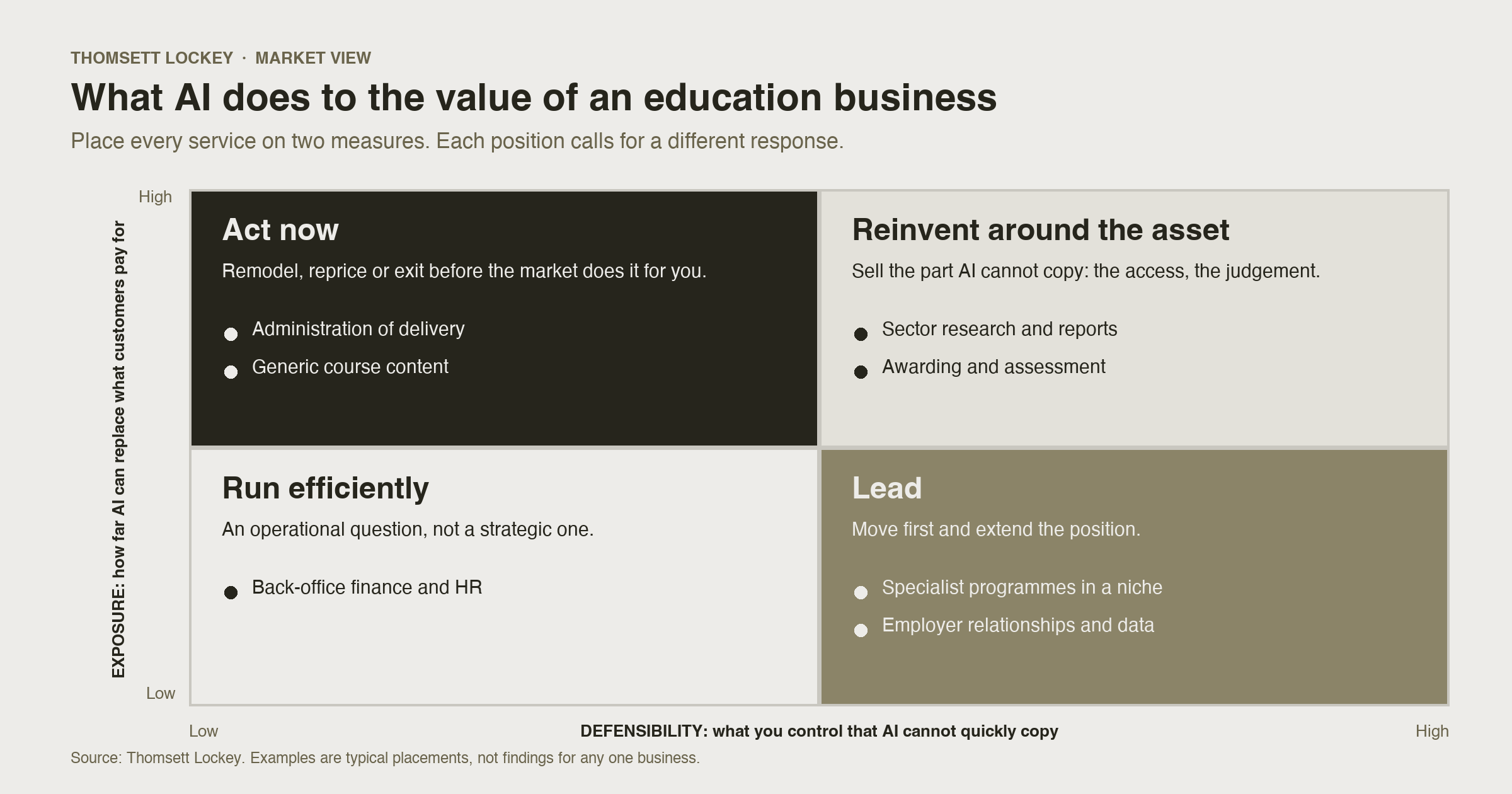
High exposure, low defensibility: act now. Remodel it, reprice it or exit it before the market does it for you. For most providers this is the administration of delivery. Automate it first and put the time back into learners and employers.
High exposure, high defensibility: reinvent around the asset. Move what you sell towards the part AI cannot replicate. A business whose reports can be imitated, but whose employer access cannot, should charge for the access and the judgement.
Low exposure, low defensibility: run efficiently. Treat it as an operations question and keep it off the board agenda.
Low exposure, high defensibility: lead. Use the position to move first and extend it. A specialist provider in an underserved sector is usually held back by how many employers it reaches. That is a growth problem, and it is the cheapest one to solve.
Then grade each move by urgency. Decide now, where waiting carries a real cost. Prepare, where the direction is clear but the timing is not. Watch, where the signal is not yet strong enough to act on, and write down what would change that.
Where this goes next, and how sure I am
Forecasts in this area age badly, so here is my read with the confidence attached.
Decide now. The cost of administering learning will fall sharply over the next one to two years, and providers that remove it first will keep the margin. Buyers will ask for cost to serve per learner and how it is moving. Have the number, and have it going the right way.
Prepare. The new AI standards will crowd quickly and price competition will follow, probably within 12 to 18 months. Differentiation will come from employer outcomes and sector depth. Programmes without AI capability built in will date.
Watch. Assessment is where the biggest question sits. AI that marks written work for vocational qualifications is already attracting investment. Awarding and end point assessment rights are a strong asset today. Whether they stay one depends on how the regulators respond, and that is not settled yet.
What AI does is make the market better at telling the difference between the parts that are worth something and the parts that are not. Owners who can show that difference clearly, with evidence, will sell for more than owners who cannot.
If you are thinking about a sale
If a sale is two or three years away, this is the right time to answer these questions, because the answers take a year to show up in the accounts. A buyer will ask them either way. It is better that you have asked them first.
We advise owners of education and training businesses on selling, and acquisitive groups on buying, from the same deal intelligence behind this piece. The first conversation is short, direct and costs nothing.